
Shanghai, China
Shanghai
Shanghai International Circuit
- Length
- 5.451 km
- Corners
- 16
- First GP
- 2004
- Races held
- 19
- Lap record
- 1:32.238
Michael Schumacher, 2004
About Shanghai
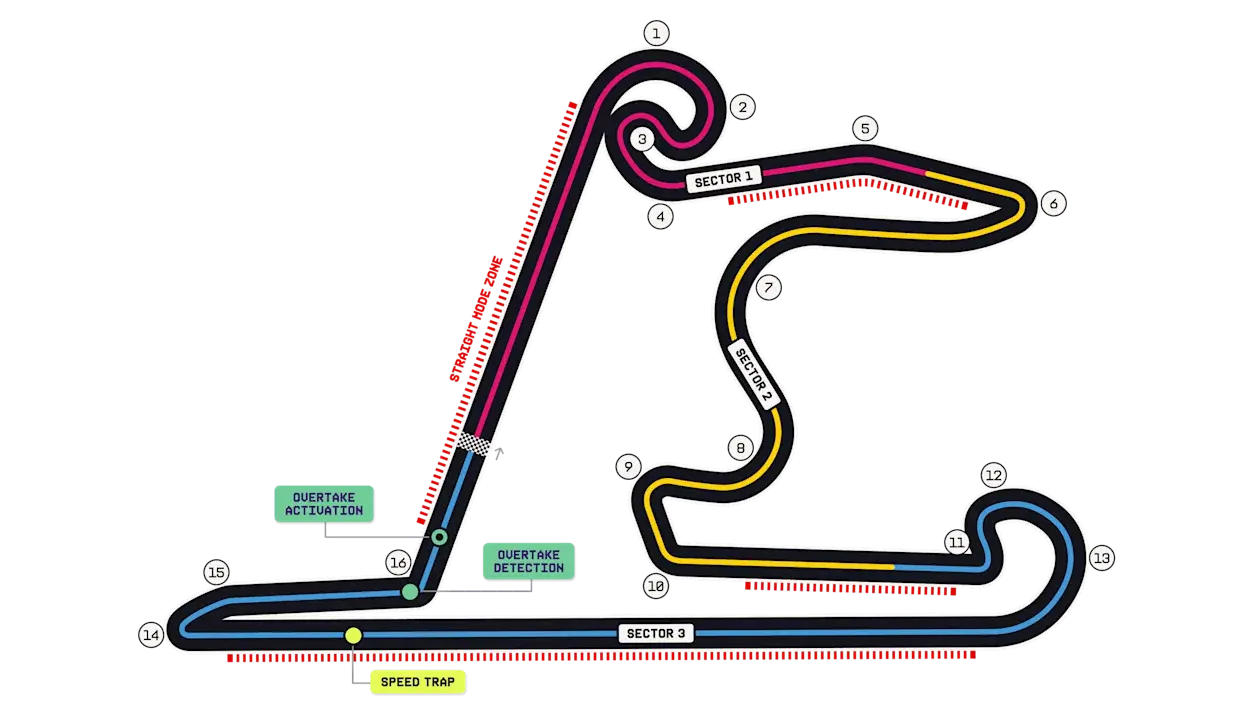
Shanghai International Circuit is a 5.451 km Hermann Tilke design in the Jiading district on the north-west edge of Shanghai. Its outline is inspired by the Chinese character "shang" (上), meaning "above" or "ascend". The lap opens with one of the most distinctive corner sequences on the calendar: Turns 1 and 2 form a tightening spiral taken at about 185 km/h before the slow Turns 3 and 4, which punishes drivers who lose the rear on entry.
The back straight between Turns 13 and 14 is roughly 1.2 km long and ends at the Turn 14 hairpin, the circuit's best-known place to overtake. The mix of heavy braking, long sweeping corners and slow sections makes tyre management and front-end wear major concerns, and the circuit was resurfaced ahead of the 2025 season.
Track Sectors
Sector 1
The Turn 1–2 spiral into the tight Turns 3–4 hairpin, followed by the flowing left-right sequence that follows it.
Sector 2
Fast sweeping corners through the middle of the lap that lead onto the long back straight between Turns 13 and 14.
Sector 3
The big braking zone at the Turn 14 hairpin and the final corners that feed onto the start-finish straight.
Circuit History
Shanghai was built on former swampland used for rice paddies. Around 3,000 workers spent 18 months on the project, which cost about ¥2.6 billion, and the circuit opened in June 2004. Its paddock buildings are arranged like pavilions in a lake, a reference to Shanghai's Yu Garden. The first Chinese Grand Prix was held in September 2004 and won by Rubens Barrichello for Ferrari.
The race stayed on the calendar every year until 2019, giving Lewis Hamilton six wins, among them the 2008, 2011 and 2014 races. Michael Schumacher's 2004 lap of 1:32.238 is still the official race lap record. Because of the pandemic there were no races from 2020 to 2023, and F1 returned in 2024 with a sprint weekend. Max Verstappen won in 2024 and Oscar Piastri in 2025; Piastri also set an unofficial qualifying record of 1:30.641 that year.
In 2026 Kimi Antonelli took pole at 19 years old, becoming the youngest polesitter in F1 history, and won for Mercedes ahead of George Russell, with Lewis Hamilton taking his first podium for Ferrari. It was the first of the season's six sprint weekends, and four drivers (Norris, Piastri, Bortoleto and Albon) failed to start because of electrical and hydraulic problems.
Grand Prix Winners
- 2026
Kimi Antonelli
Mercedes
- 2025
Oscar Piastri
McLaren
- 2024
Max Verstappen
Red Bull Racing
- 2019
Lewis Hamilton
Mercedes
- 2018
Daniel Ricciardo
Red Bull Racing
- 2017
Lewis Hamilton
Mercedes
- 2016
Nico Rosberg
Mercedes
- 2015
Lewis Hamilton
Mercedes
- 2014
Lewis Hamilton
Mercedes
- 2013
Fernando Alonso
Ferrari
- 2012
Nico Rosberg
Mercedes
- 2011
Lewis Hamilton
McLaren
- 2010
Jenson Button
McLaren
- 2009
Sebastian Vettel
Red Bull Racing
- 2008
Lewis Hamilton
McLaren
- 2007
Kimi Räikkönen
Ferrari
- 2006
Michael Schumacher
Ferrari
- 2005
Fernando Alonso
Renault
- 2004
Rubens Barrichello
Ferrari